Request a Free Estimate
Need financing?
Spread your roofing project into simple monthly payments through our partner Wisetack. Checking your options takes about a minute with no impact to your credit score.
Explore financingA small leak rarely stays small in South Florida. If you are searching for roof repair in Miami, this page covers what we repair, what a repair visit involves, and how to tell a repair from a replacement. Caston Roofing is a Florida licensed contractor (CCC1328328) based in the Kendall area of Miami.
When repair no longer makes sense, see roof replacement in Miami.
If water is coming in: the first hour
Most of what helps in the first hour happens indoors, and none of it needs you on the roof.
What you can check safely from inside
- Move furniture, rugs and electronics out from under the drip and set a bucket or tub under it.
- Look at where the water shows up on the ceiling or wall. A stain next to an exterior wall points toward flashing. A stain in the middle of a room often means water has traveled along the deck or a rafter.
- If you can reach the attic safely, use a flashlight and look for damp insulation, dark patches on the wood, or drips running down a rafter. Step only on the joists, never on the drywall between them.
- If water is near a light fixture, switch or outlet, turn that circuit off at the breaker. If a ceiling is sagging with water, keep people out from under it.
What not to do on a wet roof
- Do not climb onto a wet roof. Wet tile, shingle and metal are slippery, and a fall costs far more than a leak.
- Do not walk on tile. It cracks under a person's weight and turns one problem into several.
- Do not pull up shingles or tiles to look underneath, and do not smear sealant over wet surfaces. It rarely holds and can hide the real opening.
- Do not try to tarp a roof in wind or rain.
What to photograph
- The stain or drip, once wide and once close, with the date showing on your phone.
- Any wet insulation or damp wood in the attic.
- The roof from the ground, using your phone zoom: missing or slipped tiles, lifted shingles, debris, a damaged vent or chimney.
- A short video of the drip if it is active.
Photos help us understand the leak before we arrive, and they support an insurance claim if the damage followed a storm. Then call (305) 279-0475 or send the estimate form.
What we repair
- Leaks: traced to the true source, which is often flashing, a roof penetration or a valley rather than the stain you see on the ceiling. More on roof leak repair.
- Shingle roofs: missing, cracked or lifted shingles, exposed nails and worn flashing. See shingle roofing.
- Tile roofs: cracked or slipped concrete and clay tile, and the underlayment beneath it. See tile roofing.
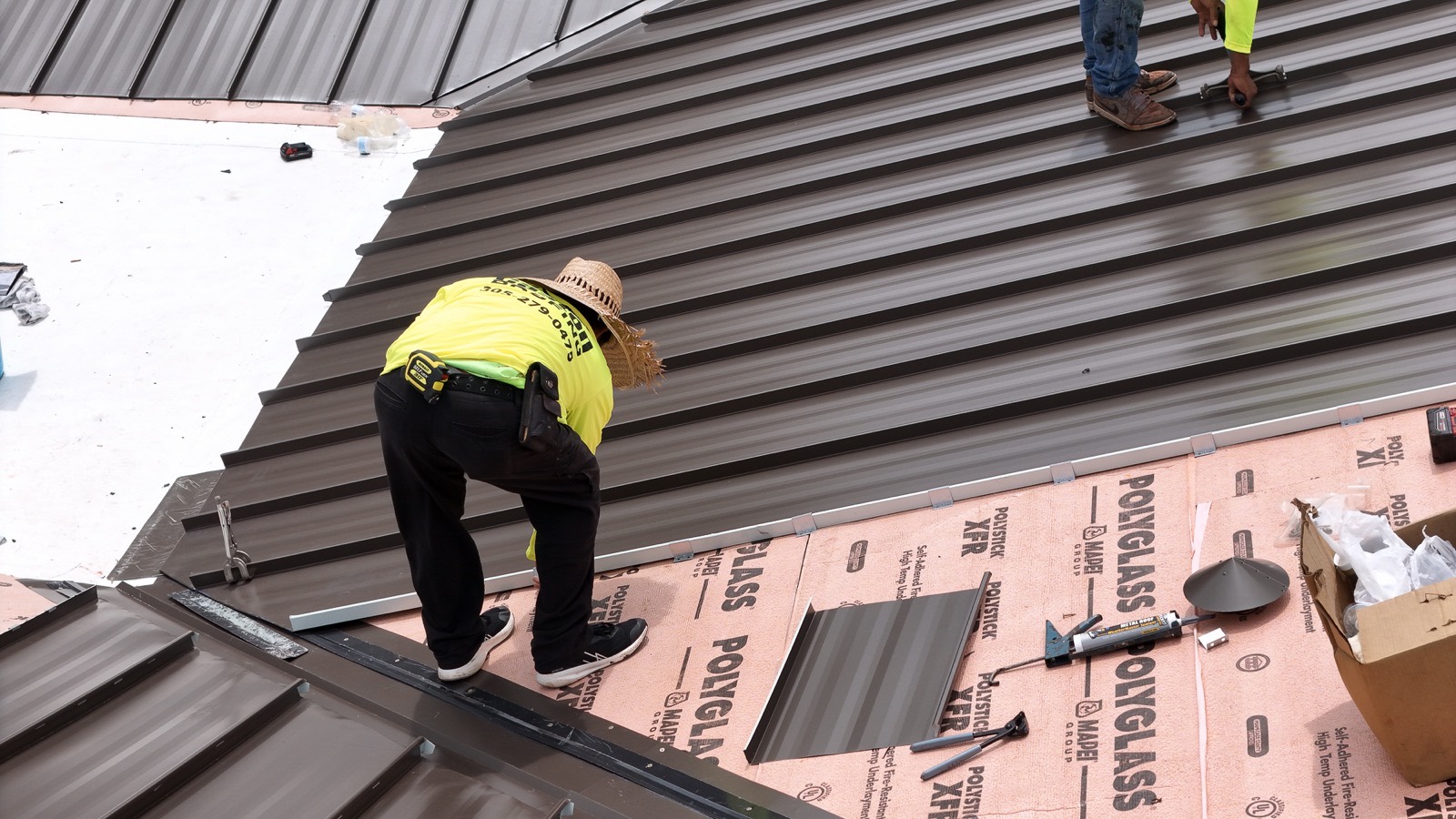
- Metal roofs: loose or backed-out fasteners, failed sealant at seams and penetrations. See metal roofing.
- Flat and TPO roofs: open seams, punctures, ponding areas and failed edge details. See flat and TPO roofing.
- Storm damage: wind and debris damage after a hurricane or a hard summer storm. See storm damage repair.
Signs your roof needs repair
- Water stains on ceilings or interior walls
- Missing, cracked, or lifted shingles and tiles
- Granules collecting in gutters or downspouts
- Damaged or rusted flashing around vents and chimneys
- Daylight visible in the attic
- Sagging areas or soft spots on the roof deck
What a repair visit involves
- You call or send the form. We offer free inspections, call (305) 279-0475 if you have an urgent leak.
- We inspect the roof. We look at the roof surface, flashing, penetrations such as vents and pipe boots, valleys, and the edges. Where we can, we also check the attic for wet insulation and stained decking.
- We explain what we found. You get the cause in plain language and your options, including whether repair or replacement makes more sense.
- You get a written estimate before any work begins.
- We make the repair, and we tell you if we see anything else that will need attention later.
Repair or replacement?
Repair is usually the right call when the damage is limited: one failed flashing, a few broken tiles, a lifted section of shingles, or a single open seam on a flat roof. Replacement is worth discussing when leaks keep showing up in different parts of the roof, shingles are losing granules across the whole surface, the deck is soft, or the roofing material is near the end of its service life. We will say so if a repair will not hold, and show you why. The inspection and estimate are free either way. If replacement is the better answer, see roof replacement and financing.
Roof repair in South Florida conditions
Wind. Miami-Dade and Broward counties make up Florida's High-Velocity Hurricane Zone (HVHZ), which has stricter roofing requirements than the rest of the state under the Florida Building Code. Materials used in the HVHZ need Miami-Dade product approval, and wind uplift at roof edges, ridges and tile is a common source of damage.
Rain. The wet season runs through the summer and into fall, with heavy afternoon downpours and wind-driven rain that finds weak flashing and sealant. Hurricane season runs June 1 to November 30.
Sun. Year-round UV and heat dry out sealants, wear shingles and cause roofing materials to expand and contract, which opens small gaps over time. Tile can look fine on top while the underlayment beneath it has worn out.
Permits. Whether a repair needs a permit depends on the scope of the work and the city or county. Large repairs can also trigger code upgrades to the repaired section. We check this before we quote, so the estimate you get matches the work that is required.
We serve homes and businesses across Miami-Dade, including Kendall, Doral, Hialeah, Miami Lakes, Coral Gables and other areas. You can also browse all of our roofing services.
Common Questions
How quickly can you look at a leak?
We offer free inspections, call (305) 279-0475 if you have an urgent leak.
Do you repair all roof types?
Yes. We repair shingle, tile, metal, flat and TPO roofs, on both homes and commercial buildings.
How do I know whether to repair or replace my roof?
It depends on how widespread the damage is and what condition the layers under the surface are in. A leak at one flashing or a handful of broken tiles is usually a repair. Repeated leaks in different areas, widespread granule loss on shingles, or soft decking usually point toward replacement. We show you what we find and give you both options in writing when both are realistic.
Do I need a permit for a roof repair in Miami-Dade?
It depends on the scope of the work and the city or county that issues the permit. Some small repairs do not need one and larger ones do. We tell you which applies to your job before work starts.
Can you repair a roof after a hurricane or storm?
Yes. See our storm damage repair page. If water is coming in, call (305) 279-0475 first so we can get you scheduled quickly.
Will you tell me if I need a full replacement instead?
Yes. If a repair will not hold long term we show you exactly why and walk you through replacement options. The inspection and estimate are free either way.
Explore more
Recent work
Our work speaks for itself.
Free inspections